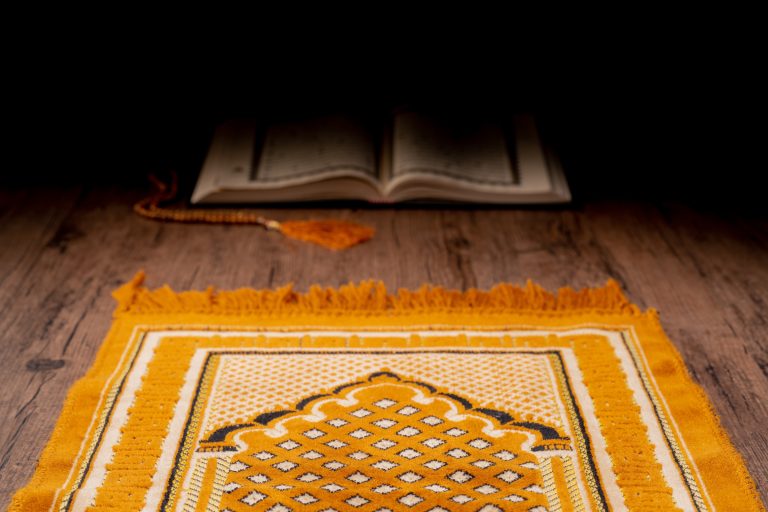
As the Salah is the faithful bond, and the spiritual communication between the Lord and His believer, every Muslim should pay great attention to its right conditions and preparations. That enables him then to duly preserve his Salah where he daily stands before His Lord, every day and night. In our lives, when we are about to meet an important person, we exert our maximum efforts to ensure that the meeting goes right, exactly as it should. Imagine meeting with the Lord of the worlds! That, definitely, can’t be compared to anything on earth. Therefore, properly performing the Salah is essential to every believer who recognizes the due significance and holiness of this divine, sacred meeting.
In the following lines, let’s highlight the core conditions and preparations of the Salah for the Muslim to make sure of abiding by them, every time he intends to perform that blessed act of worship before His Lord.
Preparations and Conditions of the Salah
As known, the Salah is not mere physical movements done by anyone, anytime! Of course, the right Salah in Islam has certain conditions and preparations to get checked first:
Being a Muslim
Fundamentally, the Salah is the second pillar of Islam, the covenant, and the special, distinguishing sign of the Muslims, from others. So, it is normal that the first condition of the Salah is being an actual believer of Islam, and being free from atheism. As the Muslim first says and believes in the Shahada, so that performing the Salah to the One Lord of all comes consequently.
Being Sane, with a Sound Mind
Allah, the Almighty, has already given the trust of mind to human beings, so that they can get to know Him, and follow the right path by choice and reason. Then having a sound mind is a prerequisite to perform all the acts of worship, and to be accountable for one’s deeds before Allah, on the Judgement Day:
The Prophet (ﷺ) said:” There are three people whose actions are not recorded, a sleeping person till he awakes, a child till he is a grown up, and an insane person till he is restored to reason or recovers his sense.“
Reported by Ahmad and al-Arba’a, except at-Tirmidhi. al-Hakim graded it Sahih (authentic).
Being an Adult, not a Child
As we can see in the previous hadith, a child is not mature enough to be held accountable for preserving the Salah, until he reaches the puberty-age, so that he can be responsible then.
Yet, to get familiar with such a sacred, regular act of worship, he should gradually practice performing the Salah since his early age, since being 7 years old, as commanded by the Prophet (PBUH): “Command your children to perform the Salah when they become seven years old…”
Purification
That part is very critical; every Muslim, before performing the Salah, needs to check that he is clean from those certain impurities…

- His Body
The body should be cleansed from the major, ritual impurity (like that of the intercourse, or menstruation) that necessitate ghusl (washing-up), and cleansed from the minor, ritual impurity (like that of passing gas, urination, defecation, or deep sleep) that necessitates just Wudu’ (the ritual ablution). Additionally, the body must be free from any dirt. So that the Muslim can stand before his Lord in the Salah, fresh and clean.
- His Clothes
As same as the body must be clean, the clothes worn while performing the Salah must be clean, too, as indicated in the Sunnah: Asma, the daughter of Abi Bakr (may Allah be pleased with her) who narrated: ‘A woman came to the Prophet (PBUH) and said: ‘If one of us sees menstrual blood on her garment, what should she do? He (PBUH) said: “Scratch it, then rub it with your fingers whilst pouring water on it and continue to pour water on it (until it is clean), and then perform the Salah in it.” [Al-Bukhari].
- The Place of The Salah
With a clean body and clothes, the Muslim must seek a clean place to perform the Salah to His Lord. So, as a Muslim, find any no-dirt place, wherever, and perform your Salah:
The Messenger of Allah (ﷺ) said: ”The earth has been made for me a masjid, and a means of purification (by Tayamum), so wherever one of my Ummah is, when the time for the Salah comes, let him perform it.” [Sahih].
- Wudu’ (Ablution), or Taymum
As said, the Muslim needs to be clean and purified for the Salah. Therefore, there is a further step to take, before the Salah: It is Wudu’ (by the water), or Taymum (with sand, when there is no water available) as commanded by Allah Almighty:
[O believers! When you rise up for the Salah, wash your faces and your hands up to the elbows, wipe your heads, and wash your feet to the ankles. And if you are in a state of ˹full˺ impurity, then take a full bath (ghusl). But if you are ill, on a journey, or have relieved yourselves, or have been intimate with your wives and cannot find water, then purify yourselves with clean earth by wiping your faces and hands. It is not Allah’s Will to burden you, but to purify you and complete His favor upon you, so perhaps you will be grateful.]
[Al-Ma’idah: 6].
- Covering the ‘Awrah
As the Salah is about such sacred modesty, purification, and communication with the Lord, Muslims need first to cover their body modestly with clean clothes to perform the Salah. So, reasonably, whoever performs the Salah naked- while being able to get dressed- his Salah is invalid and unaccepted. Allah says:
[O children of Adam, take your adornment [i.e., wear your clothing] at every masjid…] [Al-’Araf: 31]
So, in the Salah, the men must cover their ‘Awrah, below the navel and till the knee, and the women must cover up all their bodies, except the face and the hands.
- Facing Towards the Qiblah
Qiblah is the Ka’bah-direction, wherever in the world the Muslim is. Ka’bah symbolizes Allah’s House, and the unity of all Muslims praying towards the same Qibla, to the One Lord. So, facing towards the Qiblah is a must for an accepted Salah, as Allah, the Almighty, commanded:
[We have certainly seen the turning of your face, [O Muḥammad], toward the heaven, and We will surely turn you to a qiblah with which you will be pleased. So turn your face [i.e., yourself] toward al-Masjid al-Ḥarām. And wherever you [believers] are, turn your faces [i.e., yourselves] toward it [in the Salah]…]
[Al-Baqarah: 144].
- Niyyah: Setting the Intention
The intention is actually the essence of all the acts of worship for Allah, as intention is what adds the needed spirit of faith, and meanings to the physical rituals of worship, and as result, it strengthens that divine bond between the servant and His Lord.
As same as the other acts of obedience to Allah, setting the intention for the Salah before performing it, is a necessity, and rather, the core of its validity. Without the Muslim’s intention, his Salah is invalid. In Sunnah, Allah’s Messenger said: “Umar said: I heard the Messenger of Allah ﷺ say:
“Deeds are but by intentions and each man will have but that which he intended…” (Al-Bukhari).
- The Due Time
The Fardh, five Salahs and some, certain Naflah ones, are time-limited acts of worship. So, for example, we can’t perform a Fardh-Salah, like Al-Fajr Salah, in any time other than its due time, at the dawn, and so on, or the two Nafla Rakahs for Al-Masjed-greeting, when not being at the Masjid, and so on.
Allah, The Almighty, says, in His Noble Qur’an: [… Indeed, prayer has been decreed upon the believers a decree of specified times.]
[Nisaa: 103].
In general, Allah mentioned the timings of the Salah, and specifically revealed them to His Messenger (PBUH) in detail, as in the Sunnah:
[Perform As-Salah from mid-day till the darkness of the night (i.e. the Zuhr, ‘Asr, Maghrib, and ‘‘Isha Salahs), and recite the Quran in the early dawn (i.e. the Fajr prayer). Verily, the recitation of the Quran in the early dawn (i.e.— Fajr Salah) is ever witnessed (attended by the angels in charge of mankind of the day and the night).” [al-Isra 17:78]
Conclusion
In the previous lines, we have mentioned the due conditions and preparations for performing right Salah, as it must be performed to be valid and accepted. Pay attention that some of them are necessary for even other acts of worship, as well, like those of being Muslim, sane, and adult, with a clear intention for the particular act of worship, while other some are somehow exclusive to the Salah, like Wudu’.
By abiding by those conditions and preparations, Insha’Allah, the Muslim’s Salah will be valid and accepted by Allah, opening the doors of His mercy, peace, and blessings. Recognizing such high spiritual greatness of the Salah, we all invoke Allah, as our Prophet Ibrahim did:
[O Allah, make me a performer of the Salah, and (many) from my offspring, O Lord, and accept our dua’]
[Ibrahim: 40].