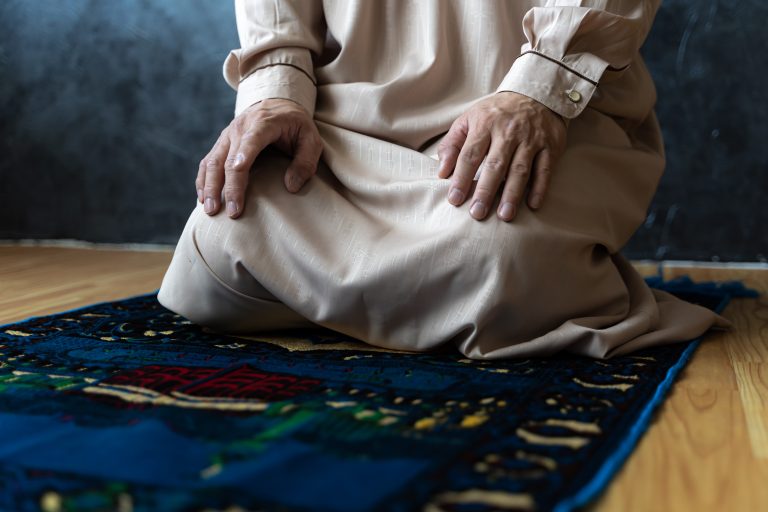
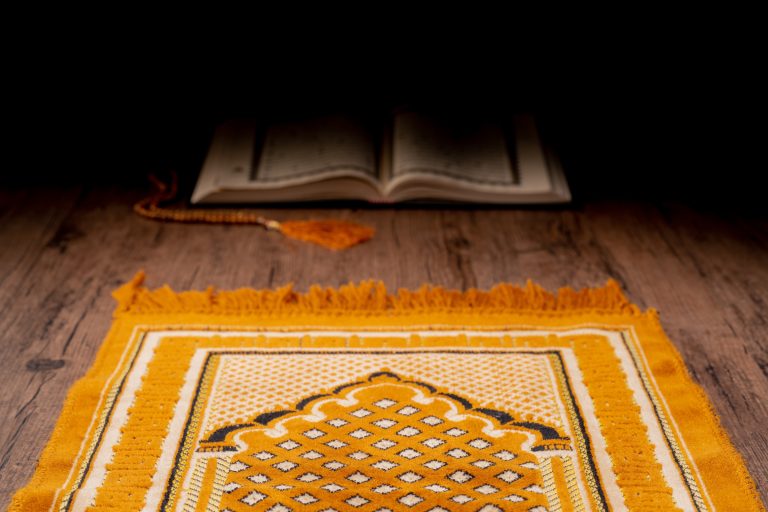
In the Arabic Language, ‘Salah’ is derived from ‘Silah’, which means connection and relation. Actually, due to its sacred significance, Salah is the second pillar of Islam, as it is considered the Islamic rituals that spiritually connect the believer to His Lord, and regularly strengthens his relation with Him. As a Muslim, performing the Salah is fundamental and crucial, as it is the faith-covenant to keep, to stand out as a Muslim, away from the non-believers. Therefore, there are key points to consider when it comes to performing the Salah: Whether it is Nafila or Fardh, the checklist before performing the Salah, how to actually perform the Salah, and the proper manners when performing the Salah.
The Fardh and Nafila
Salah is a part and parcel of the Muslim’s daily life. Yet, not all the Salahs are obligatory to perform. There are two main types of Salah in Islam:
- The Fardh Salah
Fardh means ‘obligatory and must to perform’. Then, for keeping that divine, faithful connection between the believer and his Lord, in Islam, there are daily, regular, five, Fardh Salahs that are requisite to perform: those of (Fajr, zuhr, Asr, Maghrib, and Isha’).
Those five Salahs are what Allah commanded His believers to perform every day and night, in their due times, after their Adhan (the timed call for each Salah); Allah says: [… perform the Salah. Indeed, Salah has been decreed upon the believers a decree of specified times.] [An-Nisaa: 103].
The Muslim must not skip those Fardh Salahs, as they are definitely what distinguish him as a Muslim, and keep him protected from deviation and even disbelief! Thus, not performing them is a major sin that brings Allah’s displeasure, punishment, and the doom of disbelief.
- The Nafila Salah
Nafla means ‘extra’. Therefore, the Nafla Salah refers to the non-obligatory, voluntary Salah that the Muslim performs for extra good deeds and rewards from Allah, and as an ‘extra mile’ to draw nearer to Allah, the Almighty. They are those Salahs, other than the five Fardh-Salahs.
Yet, the Nafla Salahs also have specific times, like the Salah of Taraweeh, 8-12 Rakahs performed after Ishaa’ Salah in Ramadan.
Unlike the Fardh Salahs, the Nafla Salahs are not obligatory to perform, so skipping them are not considered a sin, but they are so recommended for the Muslims for a higher level of righteousness, faith, and nearness to Allah, gaining more of Allah’s pleasure and reward.
The Checklist before Salah
Before performing the Salah, you need to check those first:
- The Due Time of the Salah
It is the due time for the Salah; make sure it is the dawn, before sunrise, to perform the Fajr Salah, for example, as each of the five Salahs has its due time. Actually, Adhan is mainly meant for this role, so once you hear the Adhan of a certain Salah, get up and prepare yourself to stand in Salah before your Lord!
- Purification
You’re purified from the major impurities by ghusl (washing-up) after intercourse or menstruation, and by Wudu’ (ablution) after passing gas, urinating, defecating, or deep sleep.
- Wudu’
Perform the Wudu’ (Ablution). Start with saying Bismillah, and perform Wudu’. For sure, you can’t perform the Salah without making wudu’ first, as Allah’s Messenger said: “The Salah of a person who does not perform ablution is not valid, and the ablution of a person who does not mention the name of Allah (in the beginning) is not valid.” [Sahih]
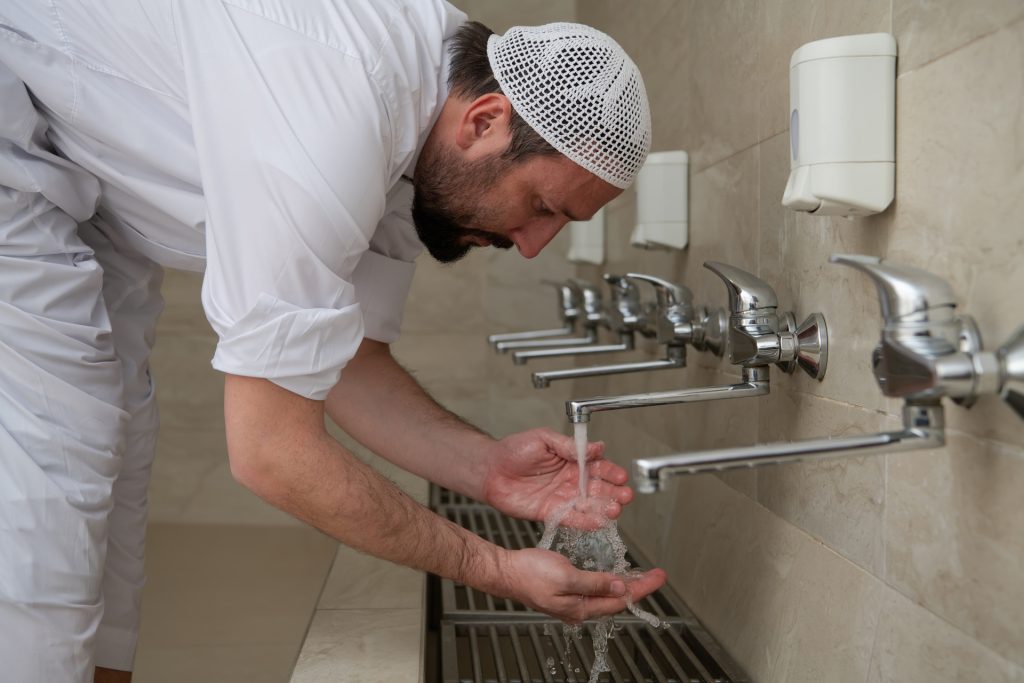
Here are the steps of Wudu:
1- Set the intention (Niyyah) in your heart, and say “Bismillah” (In the name of Allah).
2- Wash both hands up to the wrists three times, starting with the right hand, ensuring water gets between fingers.
3- With your right hand, rinse your mouth thoroughly three times.
4- Sniff water into your nose with your right hand and blow it out with the left three times.
5- Wash your entire face from forehead to chin and ear to ear three times.
6- Wash your right arm from fingertips to elbow three times, then, repeat the same with the left arm.
7- Wet your hands and wipe them over your head from forehead to the back and then bring them back to the forehead.
8- Use your fingers to clean the inside of your ears and behind them, once.
9- Wash your right foot up to the ankle, cleaning between the toes, three times, then repeat with the left foot.
10- Recite the post-wudu dua (supplication).
- Directing to The Qibla
When performing the Salah, you must direct yourself towards the Qibla, towards Ka’ba, Allah’s House.
- Setting Niyyah for the Certain Salah
You can’t intend for Al-‘Asr Salah, for example, while you are about to perform the Ishaa’ Salah! Set your clear attention for the specific Salah you are about to perform.
How to Actually Perform the Salah
After checking the previous list, you can start your Salah, but first, remember the numbers of Rak’ahs of each of the five, Fardh Salahs:
Fajr (2 Rak’ahs), Dhuhr (4 Rak’ahs), Asr (4 Rak’ahs), Maghrib (3 Rak’ahs), and Isha (4 Rak’ahs)
Here are the steps of performing Salah:
1- Takbir al-Ihram: Raise hands to ears, and say “Allahu Akbar” (Allah is the Greatest).
2- Qiyam (Standing): Place hands on chest (right over left) and recite opening supplication (optional), then Surah Al-Fatiha, and another short chapter from the Quran.
3- Ruku’ (Bowing): Say “Allahu Akbar,” bow, placing hands on knees, keep back straight, and say “Subhana Rabbiyal Adheem” (Glory be to my Lord, the Magnificent) three times.
4- I’tidal (Standing Up): Rise straight, saying “Sami Allahu liman hamidah” (Allah hears those who praise Him), then “Rabbana lakal hamd” (Our Lord, to You is praise).
5- Sujud (Prostration): Say “Allahu Akbar,” prostrate with forehead, nose, palms, knees, and toes touching the ground, saying “Subhana Rabbiyal A’la” (Glory be to my Lord, the Most High) three times.
6- Sitting: Say “Allahu Akbar,” sit up shortly between prostrations.
7- Second Sujud: Say “Allahu Akbar,” and prostrate again, saying “Subhana Rabbiyal A’la” (Glory be to my Lord, the Most High) three times.
8- Stand up again and repeat the steps from 2-7, for the second Rak’ah.
9- Tashahhud: After the second rak’ah, sit for the Tashahhud and say its dua’:
““At-tah-e-yatu lill-lahy,wassalawatu,wat tay-e-batu, assalamu a’layka ay you han-nab-e you, wa rahmatullahywa barakatu, assalamu a’laynawa’ala i’badil-lahis-saliheen. Ash-hadu an la illaha illa Allah,wa ash-hadu anna Muhammadan ‘ab-do-huwa rasool-uh.” That means (All greetings of humility are for Allah, and all prayers and goodness. Peace be upon you, Oh Prophet, and the mercy of Allah and His blessings. Peace be upon us and upon the righteous slaves of Allah. I bear witness that there is none worthy of worship but Allah, and I bear witness that Muhammad is His slave and His messenger)
Note: In case, the Salah, you’re performing, is more than two Rak’ahs, you re-stand up again for the third Rak’ah, repeating steps from 2 to 7, and for the fourth, except that in the third and fourth Rak’ah, you just say Al-Fatiha Surah, without following it by another ayahs.
After the last Rak’ah, you say the complete Tashahhud:
““At-tah-e-yatu lill-lahy,wassalawatu,wat tay-e-batu, assalamu a’layka ay you han-nab-e you, wa rahmatullahywa barakatu, assalamu a’laynawa’ala i’badil-lahis-saliheen. Ash-hadu an la illaha illa Allah,wa ash-hadu anna Muhammadan ‘ab-do-huwa rasool-uh. Allahuma sully a’la Muhammad,wa ‘ala aly Muhammad, kama sullayta a’la Ibraheem,wa ‘ala aly Ibraheem, innaka hameedun majeed. Allahuma barik ‘ala Muhammad,wa ‘ala aly Muhammad, kama barakta ‘ala Ibraheem,wa ‘ala aly Ibraheem, innaka hameedun majeed.”
(All greetings of humility are for Allah, and all prayers and goodness. Peace be upon you, Oh Prophet, and the mercy of Allah and His blessings. Peace be upon us and upon the righteous slaves of Allah. I bear witness that there is none worthy of worship but Allah, and I bear witness that Muhammad is His slave and His messenger. Oh Allah, bestow Your favor on Muhammad, and on the family of Muhammad, as You have bestowed Your favor on Ibraheemand the family of Ibraheem. You are Praiseworthy, Most Glorious. Oh Allah bless Muhammad, and the family of Muhammad, as You have blessed Ibraheem, and the family of Ibraheem, You are Praiseworthy, Most Glorious.)
10- Tasleem (Salutation): After finishing the Rak’ahs of the Salah, turn your head to the right saying “Assalamu alaikum wa rahmatullah” (Peace and mercy of Allah be upon you) and then repeat to the left.
The Proper Manners for the Salah

Some manners are recommended for performing a perfect Salah:
Detach from the World
In the Salah, you are actually in a spiritual communication with the Lord with the World! So, why thinking about anything else! Be present in this solemn moment!
Slow Down
There was one of the Muslims who performed the Salah quickly, and the Messenger (PBUH) saw him, so he (PBUH) asked him to repeat his Salah, again and again, as it is inappropriate to rush in the Salah. Feel each movement and dua’ in the Salah, seeking your Lord’s guidance and mercy.
Keep Your Gaze Low
You should keep your eyes down, looking at the prostration spot on the ground. That enables you to stay focused, and heedful of Allah, and to show the due respect, submissiveness, and reverence to Your Lord, the King of all Kings.
Follow the Imam
When performing the Salah in group, in the Masjid, or wherever, you should follow the Imam; do as he does, and move after him, not before, nor with him. After the Imam finishes the Salah, complete yours, in case of missing any part of it.
Keep Calm and Quiet
Stop moving unnecessarily in general, and don’t raise your voice too high when reciting, as that may interrupt the others while they try focusing on performing the Salah.
Conclusion:
At the end, it is critical to carefully learn how to properly perform the Salah, as it is the way to know how to keep spiritually in touch with your Creator.
Always remember the hadith of Allah’s Messenger (PBUH): “The first of his deeds for which a man will be taken into account on the day of resurrection will be his Salah. If it is sound he will be saved and successful, but if it is unsound he will be unfortunate and miserable. If any deficiency is found in his obligatory Salah, the Lord will issue instructions to consider whether His servant has said any voluntary Salah, so that what is lacking in the obligatory Salah may be made up by it. Then the rest of his actions will be treated in the same fashion.”
O Allah, we ask You, for making us among the proper Salah-preservers, and among those devoted in all their deeds only for You, and Your Face: [Say, “Indeed, my Salah, my rites of sacrifice, my living and my dying are for Allāh, Lord of the worlds.] [Al-An’am: 126].